What happened?
He Lived in a Cave With No Clock. It Explains Where Your Years Went.
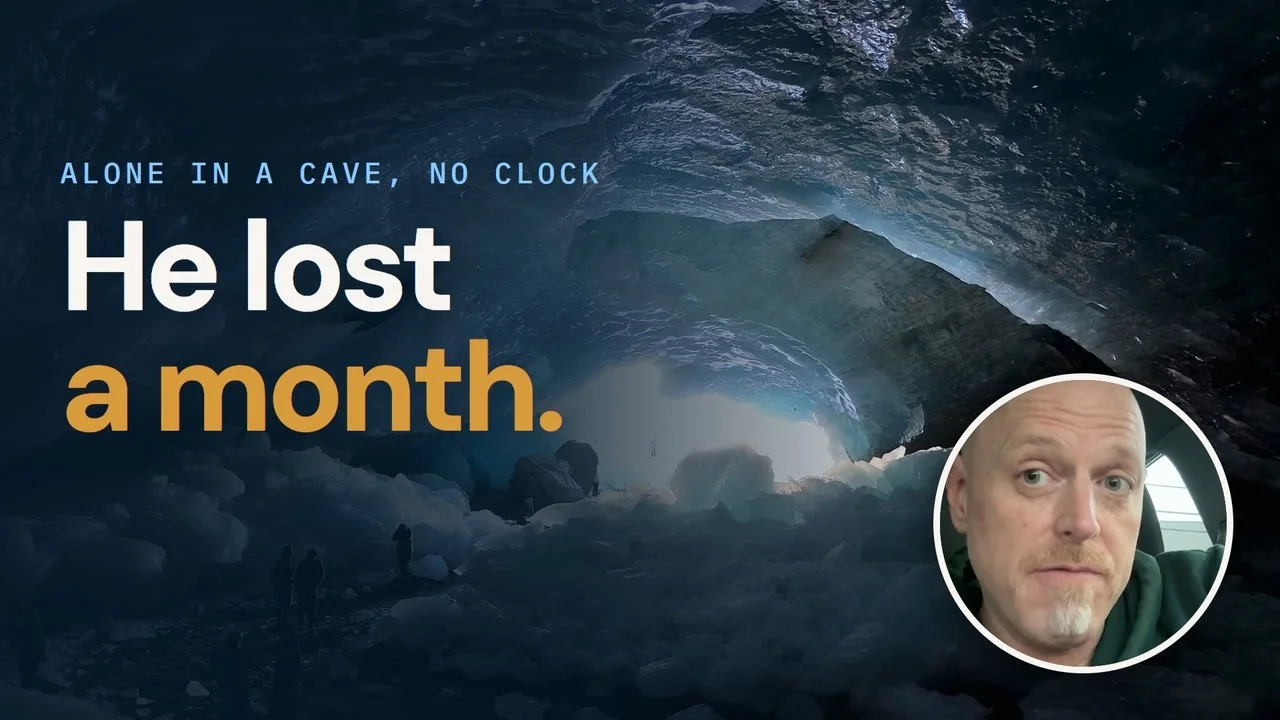
Michel Siffre lived underground without a clock. I talk about his experiments and why our own years can blur together.
Notes and sources
- Michel Siffre and Joshua Foer, Caveman: An Interview with Michel Siffre (2008).
- Ruth S. Ogden, The passage of time during the UK Covid-19 lockdown (2020).
- Aaron S. Heller and colleagues, Association between real-world experiential diversity and positive affect relates to hippocampal–striatal functional connectivity (2020).
- Claudia Hammond, Time Warped: Unlocking the Mysteries of Time Perception (2012).
The Climb
The Climb comes out every Thursday. New videos go in it too.
One email a week. Unsubscribe whenever.
Read the transcript
Michel Siffre had just finished counting from 1 to 120, and what should have taken him about two minutes actually ended up taking him five. And that was really just kind of when things started getting a little weird. Siffre was a 23-year-old French scientist. He was living alone inside a cave in the Alps. He had no clock, no sunlight, no calendar, and nobody telling him what day it was. He'd gone underground in 1962 just to see what would happen when a person lost every normal clue that tells us what time it is. And I want you to picture this place for a second. The cave was called Scarasson, I think. It sits up near the border between France and Italy, and Siffre had set up camp about 400 feet down on an underground freaking glacier. And so it was below freezing, the air was almost pure moisture, his feet were basically never dry, his body temperature actually dropped to about 93 degrees, and he had a tent, a cot, some food, a light, and a phone line to the surface. And so every time he woke up, every time he ate, and right before he went to sleep, he called up and he told his team what he was doing. So basically he ate when he was hungry, and he slept when he was tired, and he woke up whenever his body decided it was time to wake up. And his team stayed above ground and kept track of everything. Siffre didn't know any of it. And after a while, his brain started doing some pretty weird shit. That counting test was just kind of one example. He did it every time he called up to the surface, he would count from 1 to 120, one number per second, and it kept taking him five minutes. Like five real minutes were feeling like two to him. To me though, the bigger surprise came when the experiment ended, and his team told him it was September 14th, and Siffre thought it was actually August 20th. He somehow lost almost a month, not physically obviously, he lived every single one of those days. But in his head, they just weren't there, they were gone. And ten years later, he freaking did it again. And this time he spent 205 days in a place called Midnight Cave in Texas. He went more than six months without a sunrise or sunset or weekends or clocks or any of the normal things that we use to tell one day from the other. And so again, his sense of time just went completely sideways. Without the sun to reset it, his body clock just started drifting way off. Some stretches he'd stay awake for like 36 hours and then sleep for 12. And the whole time he had no idea. To him, a 48-hour day felt like a normal day. And that's the part that messes with me more than anything. Your brain doesn't actually measure time, it just guesses. It looks at the clues around it like light and meals and other people and things changing, and then it just makes an estimate. So if you take the clues away, that guess just kind of falls apart. But Texas was also different from the first cave he went in another way too because it got really dark. And I'm not talking about the light. The damp ruined his record player and it ruined the magazines that he was using to keep his mind busy. And so a couple of months in, he got pretty badly depressed. There's a story. He says at one point a mouse showed up in the cave and it was the only other living thing that was down there. And he got so lonely that he tried to catch it just to have some company. He actually accidentally ended up killing it. And years later, he said that the cave was still affecting him. So this isn't just some kind of fun science trivia. This is a guy that paid a real price to find out what happens to a person when every day feels like the same day. And so here's the kicker. He was 33 for that one. But then at 60, he freaking went back underground and did it again. He spent New Year's in a cave in south of France and celebrated it three days late. He missed his own 61st birthday down there. But the part I can't stop thinking about. Siffre talked later about how hard it became to remember what he'd done even just a day or two earlier. Because there just wasn't enough change. One day looked just like the next one and then the next one and then the next one. And it all became just kind of one long day. And hopefully that doesn't sound familiar, but it might. Not the cave part, hopefully, but the rest of it. Because I don't know about you, but when I was a kid, a summer felt like it lasted forever. Those three months were huge. But the thing is, back then you had new friends and new places and first time for things and a lot of dumb ideas and scraped knees and vacations and sleepovers and new schools and something new is always happening, right? But now you wake up, you have the same coffee, you go to the same job, you drive the same roads to get there, you have the same phone, you go to the same stores, you come home, you sit on the same couch and you go to the same bed every day and then you repeat it. And then so somebody says Christmas is a few months away and you're like, whoa, wait, how did we even get here? Didn't we just do Christmas? And that's to me the weird part about getting older. We say all the time that time is moving faster, but maybe it's not really moving faster. Maybe there's just less for our brains to grab on to. And I feel like we already ran this experiment once on the whole planet. If you think back in 2020, you remember COVID, right? We had no commutes, no restaurants, no trips. We were in the same house with the same people looking at the same freaking four walls every single day. And people started calling it Blursday, right? You remember that? Because nobody knew what day it was. It just felt like every day was the same as the other one. And so a researcher in the UK actually surveyed about 600 people during that first lockdown. And more than 80 % said time felt off compared to normal. For some it dragged and for others it flew. For me personally, it flew by because I was a home care nurse and nursing was crazy, but home care life is normal. And now when you look back at that stretch though, how much of it can you actually remember? And that was a few billion people in the same cave all at once, right? And so researchers have found that routine periods can feel shorter when we look back on them. And while new or different experiences also leave stronger memories. And so there's a psychologist, Claudia Hammond, she calls it the holiday paradox. You think about a week-long vacation somewhere new, right? And while you're on it, it just flies by. Next thing you know you're going home and you're packing, But then when you get home and you look back, that week feels a lot bigger. You start to remember the drive and the food and that weird hotel and the things that went well and the things that didn't go well. And so now think about a normal week at work instead. While you're in it, a Tuesday feels like it lasts forever and you can't wait for 5 o 'clock to come, right? But then if you look back a month later and that whole week, you can't remember it from the next. The whole thing is gone. You can't tell one week from the other. So you basically have two clocks running. One runs while you're living it and the other runs when you remember it. And the thing is routine is going to win on that first clock all the time and then it's going to lose on the second clock though. And so when you're 45 years old asking where the last 10 years are freaking gone, that second clock is the one doing the talking, right? And that makes sense because your brain doesn't need 200 separate memories of driving that same road to work. It can pretty much file them all under driving to work. Done. That's it. Nice and efficient. That's what your brain likes, right? And that's also kind of freaking terrifying because you can be busy as hell and just still have months of your life just blur together. You worked. You paid bills. You did laundry. You answered texts. You watched things on TV. You handled just a million little things. And then somehow you look up and that whole year is gone. I don't think the answer is just blowing up your life and moving to Bali or something, you know, or jumping out of airplanes every weekend. It's not really what I'm getting at. I think it's probably just a lot smaller than that. I think it's maybe just do something you haven't done. Go somewhere you haven't gone. My wife and I have never been there, never done that. If we've never been there or never done it, we like to do it. So maybe just do something you're bad at. Talk to somebody new. Take the other road home from work one day. There's real data behind this. So in 2020, researchers tracked the phone of 122 people in New York and Miami for three or four months. And on the days that people moved around more and spread their time across different places and they did different things, they actually reported feeling better. And then that good mood actually carried into the next day, too. And when the researchers scanned the brains of the people, the effect of that was the strongest on those people who their memory centers and their reward centers were more tightly linked. So that tells me new places, better days, right? Freaking measurably, too, right? So I'd say start that thing you've been putting off because you don't know if you're going to be any good at it. But basically, just give your brain something that it can't just immediately toss into that same old shit folder. So this kind of a simple test that I personally started using and just kind of at the end of the week, I'll try to name two or three things different that happened that week that couldn't have happened in any other week. Obviously not I worked or I went to the gym because those are the things that make every week look the same. But two or three things that really make the week different from the last one. And the thing is, if you can't do that, you're probably in the cave and you need to start to find a way out. Because Siffre needed hundreds of feet of rock above his head to lose track of time. But the reality is most of us can build that same kind of cave just with our routine and our apps. And the shitty part, I think, is you don't really realize it until you look back all of a sudden and wonder where those last ten years just went. So for us, I think that cave doesn't always have rock walls. Sometimes it just has Wi-Fi, apps, and scrolling. So I don't know. I think that's information that we could use to get better. I hope that helps.